

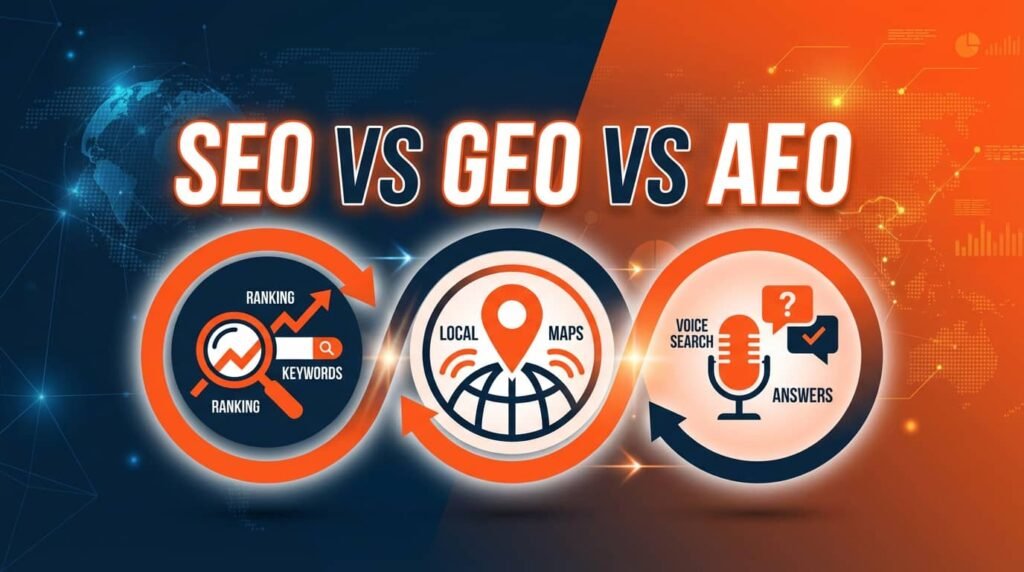

You search for “seo vs geo vs aeo” and feel lost, because your site ranks low and AI summaries skip your content. 1. Introduction: Fact: SEO, AEO, and GEO target 3 different spots, traditional search engine optimization boosts search results, answer engine optimization chases featured snippets, and generative engine optimization seeks citations in AI overviews from large language models like ChatGPT and Perplexity. 3 This post gives 4 clear steps, shows how to use keywords, XML sitemaps, backlinks, metadata, and Yext tools like Scout and the Knowledge Graph to boost Google search rankings, featured snippets, and AI citations.
Read on.
Key Takeaways
- SEO raises Google and Bing rankings to drive organic traffic and clicks by optimizing keywords, speed, schema, backlinks, and technical SEO.
- AEO targets featured snippets, knowledge panels, and voice answers with concise Q&A, FAQ schema, and 40–60 word direct answers to win zero-click results.
- GEO optimizes for AI citations by large language models like ChatGPT, Gemini, Perplexity, and Claude using schema, transparency, and frequent updates.
- Update core pages every 30 days; by 2025, consistent structured data and knowledge graphs will become essential for AI accuracy.
- Track KPIs—organic traffic, rankings, and CTR—using Google Search Console, Semrush, Yext Scout, Bing Webmaster Tools, and CMS platforms like WordPress.

What is SEO (Search Engine Optimization)?
SEO means shaping your site so search engines rank it higher, using keywords, fast pages, clear alt text, and sharp content. Marketers use crawlers, SEO tools, and analytics to watch SERPs, test click-through rates, and tune pages for search engines like Google and Bing.
Core strategies and goals
Focus on five core strategies: keyword targeting, on-page structure, technical SEO, off-page signals, and content quality. Use headers and alt text to structure pages for Google. Improve load time and mobile-friendliness, fix crawl errors with Google Search Console.
Build backlinks via guest posts, Reddit threads, and Quora answers to boost authority. Run Semrush and Google Analytics on WordPress, track 3 metrics: organic traffic, rankings, and click-through rate. 1
Aim for higher Google rankings and more organic traffic to attract customers and grow brand visibility. Target SERPs, local packs, and featured snippets to earn inclusion on results pages.
Optimize for AI-generated answers and citations used by large language models like Claude and Copilot. This fits Generative engine optimization (GEO) and AEO tactics. Compare seo vs geo vs aeo and aeo vs seo to choose between traditional seo vs generative seo approaches. 1
Importance in traditional search rankings
Google and Bing rank pages by relevance, backlinks, and technical signals. Search engine optimization (seo) boosts visibility on these engines and raises search engine rankings. Use schema markup, optimized HTML, site speed, and security to meet ranking criteria.
Make content findable, chunkable, and accessible for Google searches, apps, and users. Small business seo gains from CMS platforms like WordPress, Joomla, and Drupal, plus tight keyword optimization.
97 Switch covered tracking on July 16, 2021, so track performance with analytics and rank reports. By 2025, consistency and structured data will be critical for local SEO, because large language models (llms) and generative ai will cross-reference multiple data sources for business accuracy.
Integrate traditional SEO with AEO and GEO to keep traffic, reduce loss from AI-driven answers, and support artificial intelligence optimization. 1
What is AEO (Answer Engine Optimization)?
AEO gets direct answers to queries on the web, via featured snippets, knowledge panels, and voice assistants. Add schema.org tags and structured data, write clear answers to win Google’s answer boxes, lift clicking through, and boost credibility for marketing, Linkedin and resume pages.
Focus on direct answers and featured snippets
Target short, clear answers for featured snippets. AEO structures content to be picked as the definitive answer in AI overviews and smart speakers. Use Schema.org markup, FAQ format, and natural language, with concise 40–60 word answers, plus scannable headings and bullet points.
Prioritize visibility over clicks; content may show in answer boxes or zero-click queries on Google’s results. This reduces clicking through, so adapt traditional Seo vs Ai overview and marketing to include featured snippet tactics.
Balance Seo vs geo vs aeo, track queries in Google Search Console and WordPress, cite sources from the web, and use social media, LinkedIn, and resume-style author bios to boost credibility.
Role in voice and AI-driven searches
Because AEO focuses on direct answers and featured snippets, it shapes voice and AI-driven search behavior. Marketers must optimize short Q&A pairs and the FAQ schema to win voice queries and capture featured answers.
OpenAI, ChatGPT, Gemini, and Google’s AI systems already surface spoken responses for many query types.
AEO must be concise, structured, and citable.
AEO visibility means AI agents and voice assistants recognize your content as the direct answer. By 2025, AI search platforms will generate direct responses from a broader range of sources, they will favor structured, accurate data.
Build a knowledge graph, link facts across pages, and use conversational FAQ to earn citations for hyper-specific queries. Bloggers who study seo vs. geo vs. aeo can choose whether a query needs a blue link, a cited passage, or an instant spoken reply.
What is GEO (Generative Engine Optimization)?
GEO guides how creators shape content for large language models, knowledge graphs, and vector databases. Writers tune schema.org markup, prompts, and attribution signals to win in seo vs geo vs aeo.
Optimizing for citations in AI-generated responses
GEO ensures your content gets cited by generative models like ChatGPT, Perplexity, Gemini, and Claude. Use five tactics to earn citations: evidence-backed authority, clear structure, transparency signals, schema markup in JSON-LD, and intent-based headings. 2
Structure pages for machine readability, add schema.org markup via CMS platforms like WordPress, Joomla, and Drupal, and publish text, image, audio, and video files for wider inclusion.
Update core pages every 30 days to help AI reference your work; optimized content will raise visibility and authority in seo vs geo vs aeo results, and boost conversion rates from AI-referred visitors. 3
Building trust and authority for AI tools
GEO aims to be a cited source by LLMs and AI platforms. Sites must signal 3 attributes: factual accuracy, broad coverage, and clear transparency. Build authority via reputable directories, accurate listings, and citation-friendly content.
Use tools like LLMS.txt and Bing Webmaster Tools to register pages for AI discovery. AI visibility now relies on how models use, interpret, and discover content, not on classic SEO signals.
Make content machine-readable and contextual so knowledge graphs cite it for hyper-specific queries and users get answers without visiting your site, seo vs geo vs aeo.
SEO vs. AEO vs. GEO: Key Differences
seo vs geo vs aeo split by goals and signals—SEO aims for SERP rank, AEO aims for featured snippets and voice answers, GEO aims for AI citations. Use Schema.org, knowledge graph markup, Google Search Console and site crawlers, so Google, Bing and models like ChatGPT cite your pages.
Objectives and methods
SEO aims to rank first, to drive clicks and organic website traffic. AEO structures content into direct Q and A pairs for featured snippets and voice answers. GEO ensures factual accuracy, broad coverage, and structured data so large language models cite your pages in AI-generated responses.
SEO optimization covers keywords, CTR, and technical health, while AEO demands concise answers, and GEO demands verifiable facts. SEO shows blue links, AEO shows answer boxes, GEO yields AI summaries that may cut clicks but build authority. 3.
All three need high-quality, authoritative content, clear user intent signals, schema markup, fast mobile pages, and trust signals. Use 4 checklist items: intent-based content, schema types like article, FAQ, how-to, scannable text, and a strong technical foundation.
Apply schema markup with JSON-LD and Schema.org, check coverage with Search Console, and publish on CMS platforms like WordPress, Joomla, Drupal. By 2025, structured and consistent data will be essential, because AI will cross-reference multiple sources for business accuracy.
Use the seo vs geo vs aeo framework to set KPIs for clicks, answers, and citations. Compare platforms and technologies targeted to match Google, Bing, large language models, Knowledge Graph, and crawler requirements..
Platforms and technologies targeted
SEO targets traditional search engines, Google, Bing, and Apple Business Connect. AEO aims at direct answer surfaces, Google Featured Snippets, voice assistants, and AI overviews. GEO targets generative AI tools and large language models, like ChatGPT, Gemini, Perplexity, and Bing Copilot.
Yext Brand Visibility Platform covers AI and search, with Scout for AI-driven search and competitive intelligence. Publisher partnerships include Google Business Profile, Apple Business Connect, Facebook, OpenAI, Bing, and Tripadvisor.
For seo vs geo vs aeo audits, use Yext Scout to run a visibility scan across SEO, AEO, and GEO. GEO optimization uses schema markup, knowledge graphs, and citation-friendly formats for AI.
AI search now shows up in social feeds, maps, AI conversations, and Reddit, so brands must change tactics for each platform.
Conclusion
6. Conclusion: This quick note compares seo vs geo vs. AEO. It sets clear goals for each. SEO drives organic traffic on Google Business Profile and Bing. It raises site rank and page views.
AEO wins featured snippets and voice answers, OpenAI and Google Assistant cite concise replies. GEO secures AI citations, directory listings and an entity graph boost citation chances.
Use 3 tactics now, optimize titles, add structured data, test on CMS platforms like WordPress, Joomla, Drupal, and monitor results with Yext Scout.
FAQs
1. What is SEO vs GEO vs AEO?
SEO means search engine optimization, it helps pages rank in search results. GEO means geographic optimization; it focuses on location and local users. AEO means answer engine optimization; it aims to get direct answers and voice responses.
2. When should I use GEO instead of SEO?
Use GEO when your customers live or shop in specific places. Choose local keywords, map listings, and region pages, to match searches by location.
3. How does AEO change how I write content?
AEO asks for short, clear answers, simple headers, and structured data. Write crisp Q and A lines, add schema, aim for snippets and spoken results.
4. How do I measure success for seo vs geo vs aeo?
For SEO, watch organic traffic and rank. For GEO, track map views, local clicks, and store visits. For AEO, track featured snippets, direct answer clicks, and voice hits. Keep human review, refine often.




Pingback: SEO In 2026: What Really Ranks On Google And AI