

Introduction
Phishing is no longer obvious. Now, attackers use polished wording, spoofing, and advanced social engineering tactics powered by artificial intelligence to craft phishing emails that would pass employees’ scrutiny and bypass traditional filtering. Microsoft, for example, reported on AI-powered phishing infrastructure and hyper-personalized lures, while security vendors have been describing behavior-based and linguistic-based detection as essential for spotting modern phishing campaigns that signature-based solutions miss.
This is precisely why companies are looking at AI-powered phishing email detection tools. The most effective solutions go beyond simple anti-spam functions. Instead, they leverage analysis of behavioral patterns, linguistic characteristics, URLs, files, spoofs, and risk factors to identify phishing, BEC, and credential theft quickly. This guide explains how AI-driven phishing detection works, discusses which features are important, and provides recommendations about the best solutions.
On a side note, many companies now invest not only in cybersecurity but also in general-purpose AI marketing solutions that would optimize their email workflow.
Can AI detect phishing emails?
Yes, Artificial Intelligence has the capability of identifying phishing emails, but it is even more effective than traditional email filters because it concentrates on detecting suspicious behavioural patterns instead of just detecting known bad signatures. Most of the current enterprise-level anti-spam products on the market can utilize a number of different methods in combination with Artificial Intelligence. These include machine learning techniques, natural language processing (NLP) algorithms, types of baselining, sender reputation checks, and/or identity/ impersonation checks; they will help identify potential phishing attempts.
It is very important that we as the end-user understand the fact that the general “modern” method of conducting phishing attacks are now more talented and more sophisticated than they have been in the past, because they may never use any malware, provide clear and easy to read copy, and are usually impersonated by someone who is already trusted or has been a previously trusted vendor. The majority of products that position themselves as AI or Machine Learning-based to detect these types of Phishing-type attacks are provided by companies such as Microsoft Defender for Office 365, Abnormal Software, Proofpoint, Mimecast, and Check Point.
How does AI detect phishing emails?
AI-powered phishing detection usually combines several methods rather than one model.
First, it uses machine learning to compare incoming messages against huge volumes of phishing and legitimate email patterns. Second, it applies natural language processing to detect suspicious urgency, impersonation cues, payment requests, or abnormal tone. Third, it uses behavioral analysis to learn how your organization normally communicates, then flags unusual sender behavior, domain anomalies, or out-of-character requests. Many tools also scan URLs, attachments, QR codes, and authentication signals such as spoofing or impersonation indicators.
In practice, this means AI is asking more useful questions than an old spam filter: Does this email sound like the claimed sender? Is this vendor request out of character? Is the link destination risky? Has this user ever emailed us before? That multi-signal approach is why modern platforms are better at catching zero-day phishing, BEC, and identity-driven attacks.
Essential Characteristics for AI-Driven Anti-Phishing Software
The primary characteristics you want to pay extra attention to as you evaluate AI-Driven Anti-Phishing Email Identification Software are:
Behavioral Analysis – You will want the software to learn typical patterns of communication in order to identify deviations from the norm. This is very important when it comes to executive impersonation or vendor fraud and business email compromise (BEC).
Analysis of language and intent – You will want the software to look beyond just known malicious payloads to analyze the language (text), context, and a variety of social-engineering indicators.
Inspection of links/attachments – Real-time analysis of URLs, redirect addresses, attachments (including those that use QR codes), and email sender reputation.
Automated remediation – While some software simply generates an alert, the best software can actually quarantine the email in question, retrieve it from the recipient, or help security teams investigate the alleged suspicious email automatically.
Integration with hosted email solutions (Cloud)– The majority of enterprises are using either Microsoft 365 (formerly Office 365) or Google Workspace (formerly G Suite). Therefore, look for such integration so as to receive optimum protection from anti-phishing software that ties directly into their corporate mail system.
Few false positives (and an easy way to resolve false positives) – Detecting suspicious emails is useless if an admin does not trust the detection process or does not have a detailed explanation as to why an email was flagged in order to perform a timely reaction. One way that many of the leading competitors’ content emphasizes having the right dashboard and investigation context, as well as using explainable alerts.
Top 7 AI-Powered Phishing Email Detection Tools
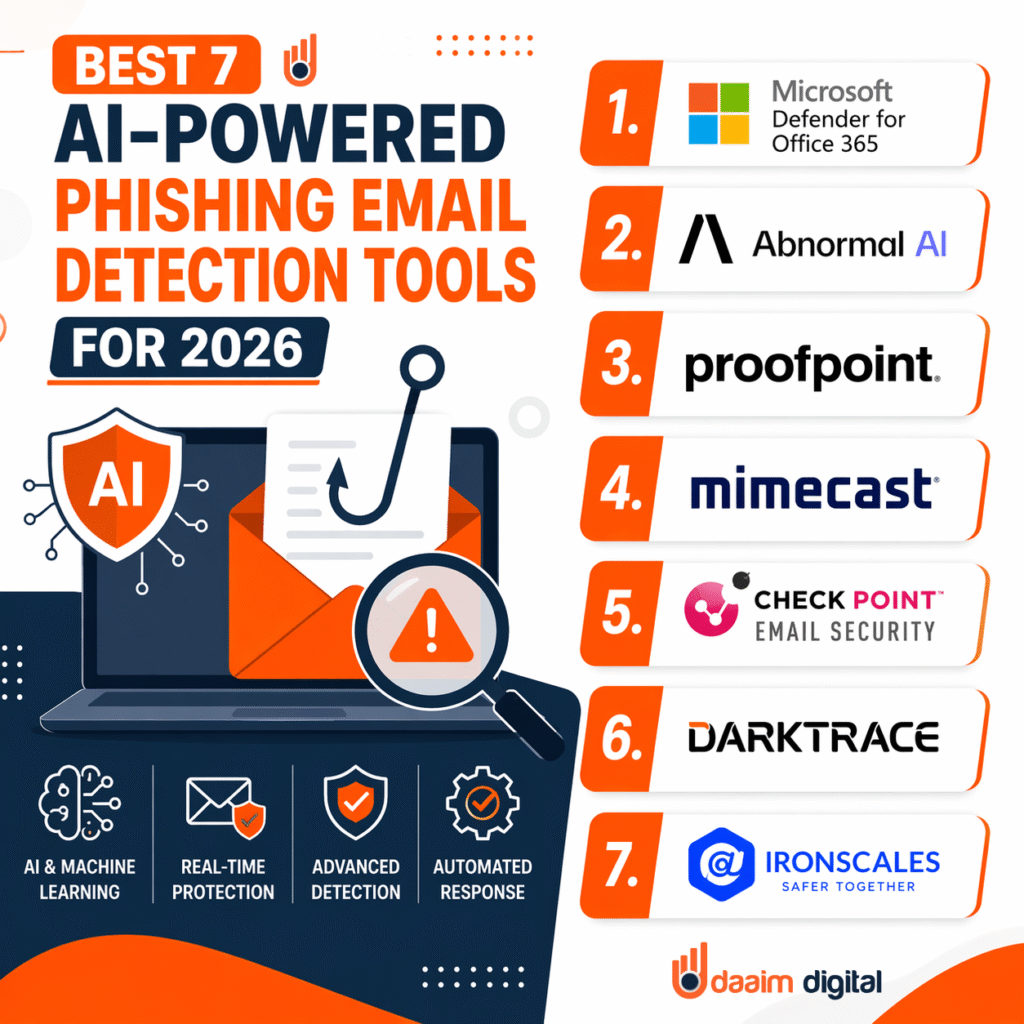
1. Microsoft Defender for Office 365
A strong choice for organizations already standardized on Microsoft 365. Microsoft offers anti-phishing policies, impersonation protection, and a newer Language AI for Phish model that learns from real-world phishing attempts. It now also offers a Phishing Triage Agent to help security teams classify user-reported suspicious emails more quickly. Best for: Microsoft-centric organizations that want native ecosystem alignment.
2. Abnormal AI
Abnormal stands out for its behavioral AI approach. Rather than depending mainly on links, attachments, or static rules, it analyzes email traffic, user behavior, and configuration signals to catch BEC, vendor fraud, account takeover, and credential phishing. Best for: teams focused on social-engineering-heavy threats and cloud email protection.
3. Proofpoint Core Email Protection
Proofpoint remains one of the best-known names in email security. Its current positioning emphasizes AI, real-time threat intelligence, machine learning, and behavioral analysis, and it says Core Email Protection blocks 99.999% of advanced email threats. Best for: enterprises that want broad email security maturity and a long-established vendor.
4. Mimecast
Mimecast combines machine learning, purpose-built AI, and deployment flexibility for email and collaboration security. It highlights malicious link blocking, identity threat detection, and credential-theft prevention, making it attractive to organizations that want a broad platform rather than a single-point phishing tool. Best for: companies that want email plus collaboration threat coverage.
5. Check Point Email Security
Formerly known as Harmony Email, Check Point’s email product emphasizes AI-powered protection for phishing, malware, and BEC across Microsoft 365 and Gmail. Its documentation also notes inspection across links, attachments, sender reputation, domains, and QR-code URLs. Best for: organizations that want strong anti-phishing depth with broad signal analysis.
6. Darktrace / EMAIL
Darktrace focuses on self-learning AI and behavioral detection. The company says its email product detects novel threats faster on average than other solutions and is designed to catch threats beyond traditional feeds by learning the business itself. Best for: organizations that value anomaly detection and cross-domain threat context.
7. IRONSCALES
IRONSCALES combines adaptive AI, semantic and behavioral models, SOC automation, DMARC support, and security training. Its positioning is especially strong around automatic detection and remediation of phishing that gets past existing layers. Best for: lean security teams that want automation and awareness features in one platform.
How to Choose the Right AI-Powered Phishing Detection Tool
First of all, look at your email infrastructure. If you have been using Microsoft 365 for years, Defender for Office 365 will be easy to add to your shortlist. If impersonation attacks, BEC, or vendor scams pose the biggest threats, then behavioral protection systems, such as Abnormal, Darktrace, and IRONSCALES, should be on your radar. If you need a comprehensive email security suite for enterprises, you might consider Proofpoint, Mimecast, or Check Point.
For teams that regularly send out many outbound emails, picking the most compatible platforms that integrate seamlessly with modern email outreach software solutions can mitigate risks and improve your email performance.
Finally, evaluate how your future vendor compares in terms of their deployment model, level of automation, compatibility with either Microsoft 365 or Google Workspace, investigations and analysis capabilities, and handling of false positives. In some cases, a good solution is not necessarily the one that has the most functionality. It will be the product that meets the needs and capabilities of your organization. Current leading competitor pages feature such list-style recommendations for buyers.
Conclusion
The best AI-Powered Phishing Email Detection Tools do far more than filter spam. They use machine learning, language analysis, behavioral baselines, and automated responses to stop the kinds of phishing emails that traditional defenses often miss. For most buyers, the best shortlist starts with Microsoft Defender for Office 365, Abnormal AI, Proofpoint, Mimecast, Check Point Email Security, Darktrace, and IRONSCALES.
If your current email protection still relies mainly on rules and reputation checks, now is a good time to evaluate an AI-first approach. Attackers are already using AI to make phishing more convincing. Defenders should be using it too.
FAQ
Which AI-powered method is used to detect phishing attacks?
The most common methods are machine learning, natural language processing, behavioral analysis, anomaly detection, and identity or impersonation analysis. Leading vendors typically combine several of these methods rather than relying on one.
Which AI tool can help detect and block phishing emails automatically?
Several can. For enterprise use, common options include Microsoft Defender for Office 365, Abnormal AI, Proofpoint, Mimecast, Check Point Email Security, Darktrace, and IRONSCALES, depending on your environment and security maturity.
What are the best phishing tools?
The “best” tool depends on use case. Microsoft is strong for Microsoft-native organizations, Abnormal is strong for behavioral AI, Proofpoint is strong for enterprise email protection, Mimecast offers broad collaboration coverage, Check Point emphasizes multi-signal detection, Darktrace excels at self-learning anomaly detection, and IRONSCALES is attractive for automation-focused teams.
What method is used to analyze a phishing email?
A phishing email is usually analyzed through a mix of content inspection, sender and domain verification, URL and attachment analysis, authentication checks, and behavioral context. Modern AI tools combine these signals into a risk score or automated verdict.